Archive for the 'New Products & Services' Category
It seems that most of the popular applications and features on hand held devices have to do with entertainment and social media: music playing; games; Twitter updates. I’m pleased when I find a hand held app that meets a need.
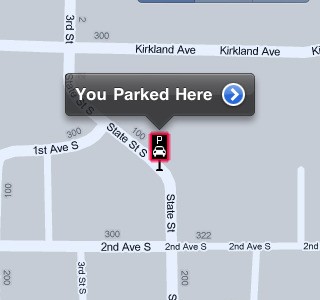
myCar Park meets a need felt by those who try to return to their car and realize that they’re unsure where they left it. When you park your car, use this iPhone app to capture the GPS location and graphically drag an indicator on a map to refine the location. Add comments such as parking level and stall number, and even a photo.
When it’s time to return to your car, click “Walk to Car” and GPS maps direct you. Brilliant!
A friend of mine could have used this app when he visited Berlin. He knew that “strasse” was German for “street”, so he made note of the street sign beside his parked car: Einbahnstrasse. When he needed to retrieve his car, he asked locals for directions to Einbahnstrasse. He then learned that “Einbahnstrasse” is German for “one-way street”. Oops.

It’s a smartphone, it’s a dockable laptop, it’s a media player. It’s all those and more. It’s the Motorola Atrix, voted best new smartphone at this year’s Consumer Electronics Show.
Much more than a smartphone, this 4G phone sports a dual core processor, like many laptops. The concept is that you have the power and capability of a PC in the size of a smartphone, which docks when you want the screen size and form factor of a laptop.
What Motorola calls widgets display real-time updates of Facebook, e-mail, Twitter, calendar and other utilities, without requiring any login or application launch. A quick glance at the home screen shows you all your new updates. It can import contacts from your accounts at Facebook, Twitter, MySpace, Gmail and more.
Atrix’s media server plays streamed or downloaded music and video. The Android-based OS lets you install Android apps to extend functionality.
Atrix can use up to 48 GB of memory, has a 960 x 540 pixel screen, and front and rear cameras.
Web browsing uses Mozilla Firefox web browser and Adobe Flash Player. The lack of Flash capability is one of the big criticisms of Apple’s iPad and iPhone, so Atrix’s capability is welcome.
When you want to work on a larger screen, dock the Atrix to the Motorola Lapdock
or, connect to a television. HDMI output lets you watch your videos or use your apps on any HD television, and you can plug in a keyboard or use a wireless keyboard.
If the Atrix sells well, it could open up a new market category for a dockable, extensible smartphone. This blurring of product boundaries is good for consumer choice.
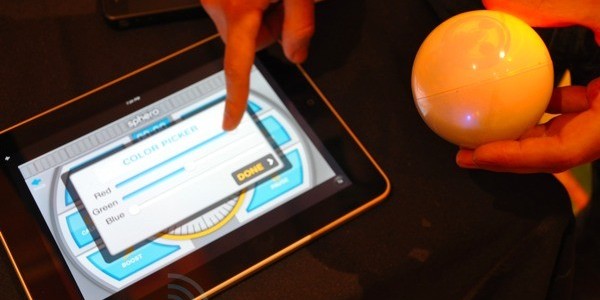
One of the hit toys at the recent Consumer Electronics Show was the new Orbotix Sphero. It’s a baseball-sized sphere that is both powered and controllable.
This self-powered sphere zips around the floor, and can do so randomly. What’s cool, though, is that it’s remote controllable via Bluetooth, using an iPhone or Android-based smart phone.
The onboard RGB LED light lets the ball glow in thousands of colors, also controllable.
Orbotix provides an open API for software control, so that third-party developers or enthusiasts can write their own apps. You could write an app for the ball to glow green when your local weather forecast is sunny and red if rainy, for it to race about in circles if a snowstorm is coming. You could have it come and remind you of missed phone calls.
With more than one Sphero, games could be programmed, to run mazes, play soccer, or maybe have a huge demolition derby.
I can’t imagine anyone needs such a thing, but it might be a good toy gift.


Apologies to Freddie Mercury for appropriating his song title. I’m really talking about tying your laptop down.
I sometimes do my work in a public library. I have my laptop open, connected via the library’s free WiFi, and listening to disks from the library’s music collection. It’s quite enjoyable. A problem arises when I need to stretch my legs or use the washroom.
While the area of the library in which I work is a less busy area, with researchers and students sharing space, one must always be cautious with a laptop. Laptop thieves operate in many public spaces where laptops are common, such as coffee shops, schools and libraries. It takes only seconds for an experienced thief to lift a laptop and disappear.
I recently obtained a laptop cable lock. This is a brilliant accessory! It’s a lightweight gadget that provides the benefit of increased security against theft. It’s rather like a bicycle lock, a braided metal cable sheathed in vinyl, attached to a lock.
The lock has a tang that fits into the Kensington Security Slot, the metal-reinforced, oval hole that is standard on almost all laptops and portable electronics. A twist of the key locks the tang in place. The cable includes a small loop, allowing the cable to be wrapped around something fixed and back through the loop, to secure the device. At the library I loop the cable around part of the fixed work station, preventing the laptop’s removal.
Even with the lock, I wouldn’t leave the laptop unattended for a lengthy period, but it’s perfect for allowing a trip to the washroom or to retrieve more books from the stacks. A determined thief could still take the laptop, but he’s have to come with a strong cutter or some picking tool. It’s more likely that the thief would just move on to easier targets.
If you often leave your laptop in a public place, you may want to consider adding other layers of protection such as an alarm and disk encryption.
Kensington lock
I like it when someone examines an old tool and figures out how to make a better one. Toronto seafood restaurateur Patrick McMurray has done just that with the oyster knife.
A four-time Canadian oyster shucking champion, 2004 North American champion, 2002 World Champion, and holder of the Guinness world record for the most oysters shucked in a minute (38), McMurray shucks a lot of oysters. He found that the typical oyster knife, with the handle as an extension of the blade, provides insufficient grip and leverage. This makes opening oysters difficult.
McMurray spent three years experimenting and making prototypes, culminating in his new Shucker Paddy knife. Its biggest difference is that the handle meets the blade at an angle, providing sort of a pistol grip. That grip and the angle provide leverage, enabling oysters to be opened with less force and more safety. The moulded grip incorporates a finger guard.
This isn’t high technology, but is innovative human technology. Having struggled with many recalcitrant oysters, I welcome the news of a better opener.
In an article I wrote at the beginning of this year, I asked if 2011 would be the year of the tablet. Even this early, it appears that 2011 will be huge for tablets.
17 million tablets were sold last year, and analysts expect at least two to three times that many to sell this year. The level of growth is four times that of smart phones and five times that of PCs.
Yesterday Apple launched the iPad 2. Its most striking difference is that it is very thin. It looks cool. As a tech obsessed friend used to say, this has a high “Batman factor”.
New features include a front facing camera for video chatting, and a rear facing one for taking photos or video capture. Video mirroring makes its first iPad appearance. This is a function that should have been in the first iPad, as it’s a common use of laptops. The new iPad Smart Cover is slick, a thin, brightly coloured, magnetic cover that automatically wakes the iPad when opened and sleeps it when closed.
To me, the iPad 2 seems evolutionary rather than a major new design. Speculation is that the iPad 3, planned for later this year, will be more innovative.
I was glad to see Steve Jobs presenting at the launch. He’s been absent due to cancer treatment, causing uncertainty regarding Apple’s future. Apple is stronger with him than without him.
As tablet sales grow, it’s clear that Apple no longer owns this market. Consulting firm PFTM says that 102 tablets are currently on sale or in development. There is excitement regarding the imminent launch of RIM’s Blackberry PlayBook, especially from corporate buyers. Products from Samsung and HP show that designs smaller than the iPad may, with increased portability, attract buyers who didn’t want an iPad. I expect that Apple will lose market share, but gain revenue as the market size grows.
If you want a tablet, it may be worth waiting to see the newer iPad 3 which will be out in the fall, as well as the upcoming Blackberry PlayBook and other competitors.

Apple today released its new MacBook Pro laptops. There is a 13″ using Intel’s integrated graphics, and a 15″ and 17″ that use dedicated AMD graphics cards. As with many new laptops from competitors, these feature Intel’s new Sandy Bridge processors.
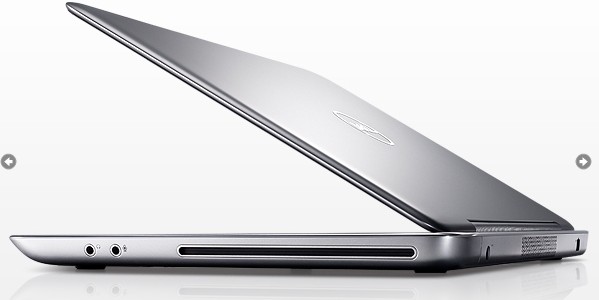
These are beautiful looking laptops. They have a sleek brushed aluminum look, with gentle curves. In appearance they are similar to earlier models, though of course the specs have improved.
There’s a significant premium required to own a MacBook. One can buy a good looking Windows laptop that is faster and more feature rich for less money. For example, at my quick glance a MacBook Pro appears about 50% more expensive than a similarly powered Dell XPS laptop.
Of course none of that will discourage the Apple fanboys, who would never consider a non-Apple computer. I read a MacBook owner sum up the choice as “fashion accessory or highly functional, take your pick”. For many Mac owners, fashion accessory trumps a more functional Windows machine every time.

![]()
![]()
The Internet and media rumour mills are buzzing this week. Pundits and fan boys are speculating about the anticipated next generation iPad.
No less a voice than the Wall Street Journal is helping to spread the rumours. The newspaper cites people “familiar with the matter” reporting that the new iPad will have a faster processor, more memory, and will be thinner and lighter than the first iPad.
Wow, what shocking revelations! Without any insider knowledge whatsoever, I’d be pretty safe in making those predictions of any new iPad, or in fact any new Apple computer or music device.
Industry analysts expect the new iPad to include a webcam. Other rumours suggest two webcams, both front and back mounted, as well as an SD card slot.
The tablet market is hot, hot, hot at the moment, so even just a rumour about the flagship brand attracts attention. However, Apple no longer owns this market. Many competitors announced new tablets at last months Consumer Electronics Show.
In particular, the PlayBook from Canada’s Research In Motion, maker of the BlackBerry, is expected to be appealing. The PlayBook is light and thin with fast processing, HD cameras, and excellent video display quality.
Both RIM’s PlayBook and the new iPad are expected in the next two months, along with other competitors. If you’re shopping for a tablet, it would be worth waiting.

Apple iPad and RIM PlayBook
Here’s something different: a mouse that sits on your finger. Mouse buttons are on the left side, and are pressed with your thumb. There is also a thumb-operated scroll wheel. The tip of this device contains the optical sensor, which you move across virtually any surface to control your cursor/pointer.

This tiny mouse is designed for situations where you have limited mousing space. One user uses it when on airplane flights, as the space for a laptop on a seat tray is rather small. You might ask why such a person doesn’t use the laptop’s built-in trackpad, but some people find those awkward or uncomfortable.
Apparently a wireless model is coming out soon.
Unlike many of the ergonomic mice and keyboards that I wrote about in December, I have neither used nor even seen this one. It does look interesting as a distinct alternative to normal mousing.
Here’s a video of someone using the finger mouse:

Toshiba’s new Dynabook Qosmio T750 has a lid that changes colour. The metallic colours appear in a range from turquoise to deep blue and purple, depending upon your angle of view. It sounds rather like iridescent silk fabric.
Toshiba says the looks is created by layering polyester laminate films, using nano-technology.
If this becomes popular, I can foresee more advanced technology being used. A thin membrane of conductive material with electrically-sensitive chemicals could wrap the laptop case. Varying current inputs could create an ever changing colour display, like a 60s lightshow.
Several laptop brands have lighted logos or symbols on their laptop lids. A colour changer would be a lot more interesting.